Announcing a new publication from Opto-Electronic Advances; DOI 10.29026/oea.2026.250249.
SHANNON, CLARE, IRELAND, April 30, 2026 /EINPresswire.com/ — Announcing a new publication from Opto-Electronic Advances; DOI 10.29026/oea.2026.250249.
With the rapid advancement of network communication technologies, significant breakthroughs have been achieved in high-resolution real-time video transmission. These developments have fundamentally transformed the way people interact online. Video conferencing, remote work, and online social platforms have experienced explosive growth, leading to the widespread adoption of globally recognized services such as Zoom, Microsoft Teams, Tencent Meeting, and Feishu. At the same time, driven by advances in deep learning algorithms, face recognition–based biometric authentication has become a mainstream identity verification approach in critical sectors including government and finance. However, in scenarios such as video conferencing, face recognition, and group photography, eyeglass wearers frequently encounter reflection artifacts. Specular reflections on eyeglass surfaces can obscure key facial features, degrade visual perception, disrupt user experience, and significantly increase the error rate of face recognition systems.
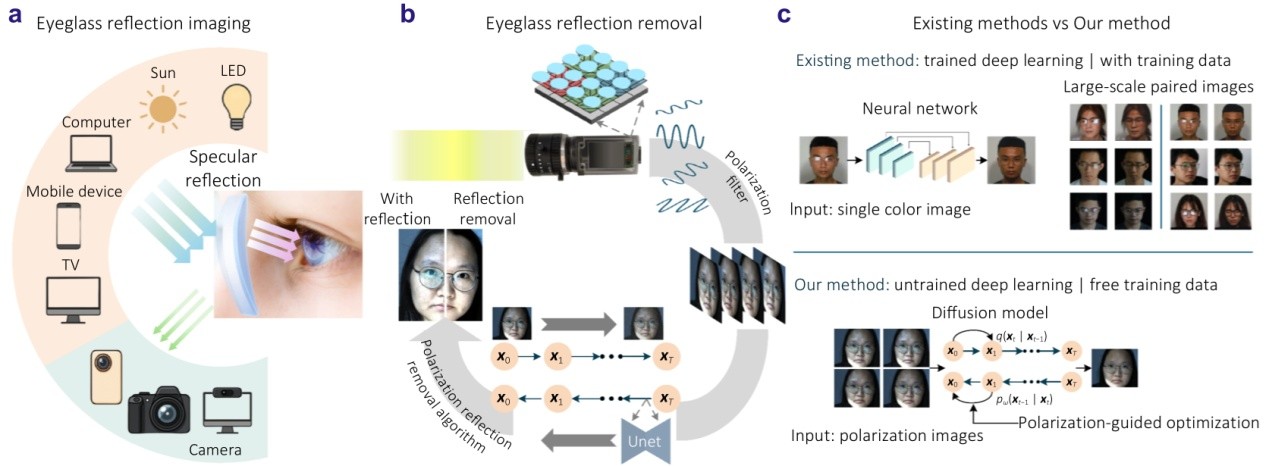
Eyeglass reflections typically consist of specular highlights, ambient scene reflections, or a combination of both. The captured image can be regarded as a superposition of a transmission layer and a reflection layer. The goal of reflection removal is therefore to effectively separate these two components in order to recover clear and reliable facial information. Existing reflection removal approaches can be broadly categorized into single-image and multi-image methods. Single-image methods lack additional cues, and thus usually rely on image statistics or data-driven deep learning models. In contrast, multi-image methods exploit variations in illumination, viewpoint, or polarization, making it easier to disentangle the reflection and transmission layers.
The current single-image reflection removal methods heavily depend on large-scale paired training data and often exhibit limited generalization capability under unknown lighting conditions, which restricts their practical applicability. Owing to the intrinsic differences in polarization properties between reflected and transmitted light, polarization filtering can partially separate the reflection and transmission components. In recent years, the rapid development of portable polarization imaging devices—such as division-of-focal-plane polarization sensors and emerging metasurface-based polarization imaging technologies—has made it feasible to acquire polarization information in real-world scenarios, further accelerating research on polarization-based reflection removal. Nevertheless, traditional polarization filtering approaches remain limited in practice and achieve optimal performance only under ideal conditions, such as when the incident angle approaches the Brewster angle and the optical path involves only a simple single-pass reflection/transmission process.
To address the above challenges, this work proposes a polarization–generation coupled mechanism for eyeglass reflection removal. The proposed method, termed PDPrior, is a polarization-guided diffusion prior model that requires neither training data nor ground-truth images, enabling artifact-free eyeglass reflection removal.
The core idea of PDPrior is to fully exploit the intrinsic prior embedded in diffusion generative models, while incorporating polarization cues into the generation process as constraints and guidance. Unlike conventional supervised learning frameworks, PDPrior relies solely on the captured polarization observations and requires neither training data nor additional annotations, significantly reducing data acquisition and model training costs. Specifically, this work constructs a self-supervised loss function based on a physical imaging model and freezes the U-Net model parameters. During the reverse generation process, the reflection and transmission variables are alternately updated, resulting in outputs that are not only visually realistic but also physically interpretable. By coupling generative modeling with imaging physics, PDPrior remains effective under unknown lighting conditions. Experimental results demonstrate that PDPrior can robustly remove eyeglass reflections across diverse scenarios, including indoor and outdoor environments, polarized and unpolarized illumination, different facial appearances, and various types of eyeglasses, without introducing artifacts. Moreover, PDPrior achieves higher scores on face image quality assessment benchmarks, including CR-FIQA and CLIB-FIQA, indicating its effectiveness in improving downstream face-related tasks.
Future research will focus on deploying PDPrior on resource-constrained platforms, such as edge devices, to enable efficient and real-time reflection removal. This includes model compression and one-step diffusion inference for faster processing while maintaining visual quality. In addition, extending PDPrior to nighttime imaging scenarios by exploiting infrared polarization data represents a promising direction toward all-day reflection removal.
PDPrior has broad potential applications in areas such as video conferencing systems, face recognition and identity authentication, intelligent security, mobile photography, and augmented reality. In video conferencing, clear and reflection-free facial images can significantly enhance communication quality and user immersion. In high-security scenarios such as financial services and government applications that rely on face recognition, reliable reflection removal can effectively reduce recognition errors and improve system security and trustworthiness. As a result, this technology is expected to have a positive impact on everyday work, remote collaboration, and the digital operation of society.
The source code has been publicly released at: https://github.com/THUHoloLab/PDPrior.
The test dataset is available at: https://cloud.tsinghua.edu.cn/f/a49e0f59a8a54c4eb14d/?dl=1.
Keywords: eyeglass reflection removal, diffusion model, untrained learning, polarization-guided optimization
# # # # # #
Liangcai Cao received his BS/MS and PhD degrees from Harbin Institute of Technology and Tsinghua University, in 1999/2001 and 2005, respectively. Then he became an assistant professor at the Department of Precision Instruments, Tsinghua University. He is now tenured professor and director of the Institute of Opto-electronic Engineering, Tsinghua University. He was a visiting scholar at UC Santa Cruz and MIT in 2009 and 2014, respectively. His research interests are holographic imaging and holographic display. He is a Fellow of the Optica and the SPIE. Research group homepage: http://www.holoddd.com
# # # # # #
Opto-Electronic Advances (OEA) is a high-impact, open access, peer reviewed SCI journal with an impact factor of 22.4 (Journal Citation Reports 2024). OEA has been indexed in SCI, EI, DOAJ, Scopus, CA and ICI databases, and expanded its Editorial Board to 41 members from 17 countries.
# # # # # #
More information: http://www.oejournal.org/oea
Editorial Board: http://www.oejournal.org/oea/editorialboard/list
All issues available in the online archive (http://www.oejournal.org/oea/archive).
Submissions to OEA may be made using ScholarOne (https://mc03.manuscriptcentral.com/oea).
ISSN: 2096-4579
CN: 51-1781/TN
Contact Us: oea@ioe.ac.cn
Twitter: @OptoElectronAdv (https://twitter.com/OptoElectronAdv?lang=en)
WeChat: OE_Journal
# # # # # #
Chen YT, Cao LC. Polarization-guided diffusion prior for eyeglass reflection removal. Opto-Electron Adv 9, 250249 (2026). DOI: 10.29026/oea.2026.250249
Opto-Electronic Advances Editorial Office
Opto-Electronic Advances
+86 591 2286 1222
email us here
Legal Disclaimer:
EIN Presswire provides this news content “as is” without warranty of any kind. We do not accept any responsibility or liability
for the accuracy, content, images, videos, licenses, completeness, legality, or reliability of the information contained in this
article. If you have any complaints or copyright issues related to this article, kindly contact the author above.

Media gallery