
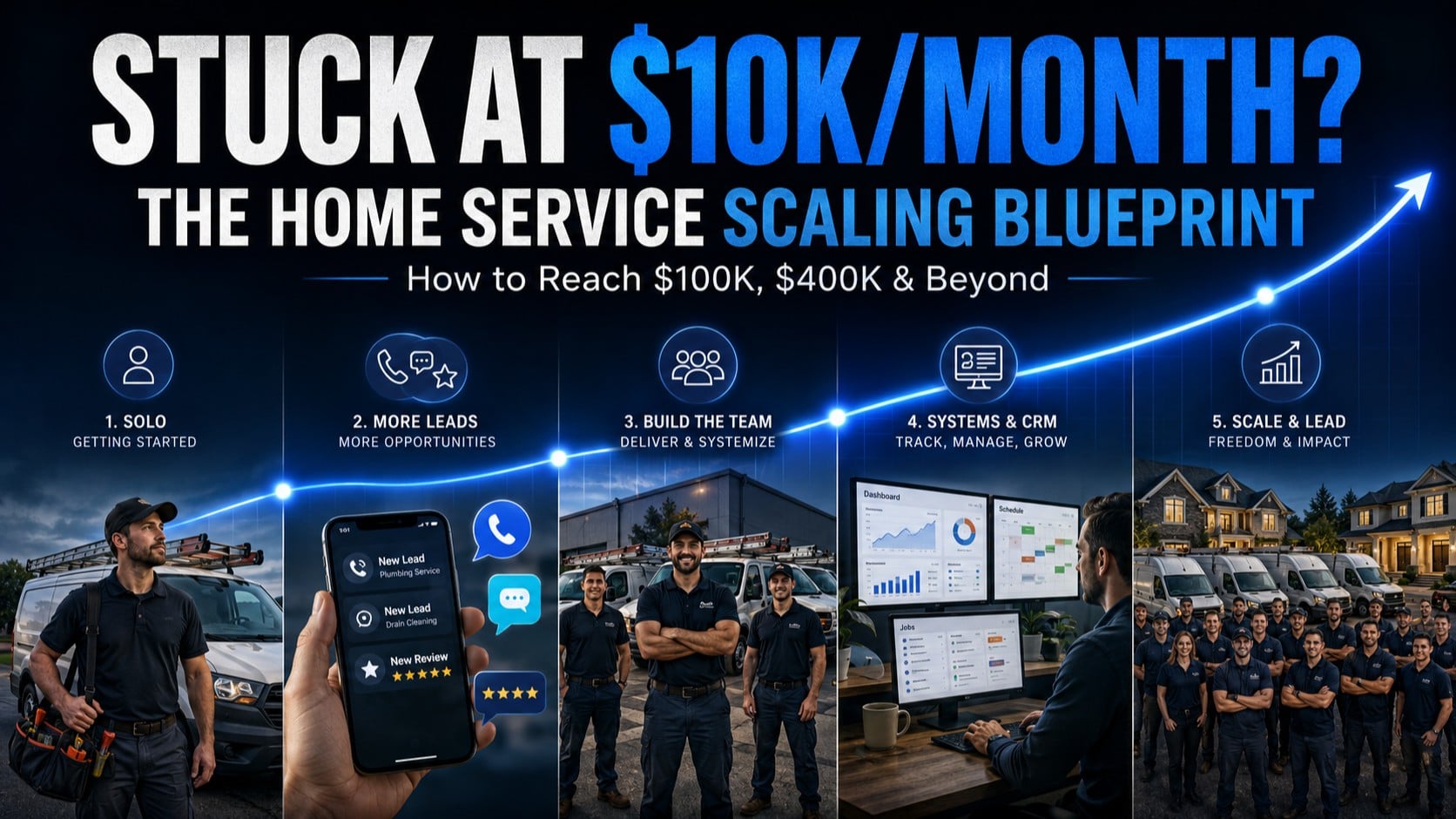
Key Takeaways
- Most contractors don’t have a lead problem; they have a sequencing problem, meaning they’re investing in the wrong solutions at the wrong stage.
- Each revenue stage from $0 to $1M+ carries a different bottleneck, and fixing the wrong one wastes time and money.
- A free gap analysis from 365 Lead Strategy can pinpoint exactly which bottleneck is holding a home service business back – whether it’s visibility, follow-up, pricing, or systems.
- Businesses that address conversion gaps before adding ad spend consistently see better returns on every marketing dollar spent afterward.
- The $300K-$600K stage is where the owner typically becomes the bottleneck, and recognizing that shift early is what separates businesses that scale from those that plateau.
Growing a home service business isn’t about doing more of everything at once. It’s about solving the right problem at the right time. A plumber who invests in Google PPC before his website converts visitors into calls isn’t scaling – he’s paying for people to leave. A roofer who hires two more crews before building a follow-up system isn’t growing – she’s creating more opportunities to drop the ball. Knowing exactly which bottleneck is limiting growth right now is the entire game.
Most Contractors Have a Sequencing Problem, Not a Lead Problem
A pattern that shows up constantly in the trades: a contractor is generating leads, sending estimates, and staying busy – yet revenue isn’t growing. The instinct is to buy more leads. But more often than not, the real issue is that existing leads aren’t being converted efficiently. Estimates sit unsold. Calls go unreturned for a day or two. The website looks fine, but doesn’t compel anyone to pick up the phone.
Skipping foundational steps creates what looks like a growth problem, but is actually a systems problem. The contractor earning $400K who never built a follow-up process is likely leaving $100,000+ in unsold estimates on the table every year – not because the leads aren’t there, but because the infrastructure to capture them never was.
What Scaling Actually Means for Trade Businesses
Scaling means growing revenue without a proportional increase in costs or owner hours. If a landscaping company doubles its revenue by doubling the owner’s workload, that’s not scaling – that’s an unsustainable grind with a bigger number on the invoice.
Real scaling happens when the systems, team, and infrastructure absorb more volume without demanding more of the owner’s time. The dispatcher handles 12 jobs instead of 6. The CRM follows up on unsold estimates while the crew is in the field. The cost to acquire and serve each new customer trends downward over time.
Revenue vs. Profitability: Which One to Protect First
A roofing company doing $600K at a 35% net margin is in a stronger position than one doing $900K at 12%. Revenue is visible and easy to celebrate. Profit is what actually funds the next hire, the next truck, and the next stage of growth. Margin must be protected at every stage, because without it, there’s no capital to invest in the systems and people that the next level requires.
$0-$100K: Visibility and Trust Before Advertising
At this stage, a business is generating roughly $5,000-$10,000 per month. Most work comes from referrals, word of mouth, and the occasional neighbor who spotted the truck. The infrastructure isn’t really a business yet; it’s a very busy self-employed person. And that’s fine, as long as there’s honesty about what the actual constraint is.
The constraint here is almost always visibility and trust, not ad strategy. Buying more leads doesn’t fix a trust problem. Building a credible local presence that makes the business look worth hiring – before anyone ever picks up the phone – is what fixes it.
Google Business Profile, Reviews, and a Converting Website
Before a single dollar goes toward paid advertising, three things need to be working: a fully optimized Google Business Profile actively collecting reviews, a simple website that clearly lists services, the service area, and a prominent phone number, and a habit of responding to every inquiry the same day. Over 76% of local mobile searches lead to a visit, call, or purchase within 24 hours, meaning a business that doesn’t show up in local results is invisible to motivated buyers.
Reviews matter just as much. Studies suggest around 93% of consumers factor in online reviews before making a purchase decision. A competitor with 47 reviews and a 4.8-star rating will win the click over a business with 3 reviews and no responses – every time. Building that trust signal systematically, rather than hoping customers remember to leave a review, is one of the highest-return moves at this level.
Pricing Mistakes That Follow Contractors for Years
Undercharging is one of the most damaging habits in the trades, and it almost always starts here. Contractors underprice out of fear of losing the job, but a net margin below 15-20% at this stage signals a serious profitability problem – a healthy net margin for home service businesses typically falls in the 15-20% range, with anything above 25% considered strong. Worse, underpricing sets a baseline that becomes very difficult to correct once employees’ paychecks depend on a broken model. Fix the pricing now. It’s far less painful than fixing it after hiring a team.
$100K-$300K: The Stage Where Costly Mistakes Happen
Hitting $100K a year confirms the business model is viable. But this range – $8,500 to $25,000 per month – is where the most expensive decisions get made. Owners feel stable enough to invest, but don’t yet have the systems to invest wisely. They hire too fast, buy equipment they don’t need yet, or pour money into advertising without a process in place to convert the leads that come in.
The methods that worked below $100K – personally handling every call, keeping everything in your head, manually tracking estimates in a spreadsheet – actively break down here. The moment a call gets missed, or an estimate takes two days to send, jobs go to competitors who have better systems, not better skills.
Follow-Up Is Now as Important as Lead Generation
At this stage, follow-up becomes a revenue channel in its own right. Sending estimates and waiting for the customer to call back is a losing strategy. Following up within 24-48 hours of sending an estimate can significantly increase booking rates, and an automated CRM workflow that triggers follow-up texts or emails after every unsent estimate can recover a meaningful percentage of those near-closes without any additional ad spend.
The same logic applies to the website. If paid traffic is running but the site isn’t designed to convert visitors into calls or form submissions, the money is funding exits, not leads. A clear headline, visible phone number, prominent reviews, and a fast mobile experience are the non-negotiables. More traffic doesn’t fix a conversion problem.
Why Identifying and Addressing Gaps Is Critical at This Level
This is the stage with the most simultaneous decisions: whether to hire, which platforms to advertise on, whether to invest in software. Making those calls in the wrong order can stall a business for years. A structured gap analysis – examining current visibility, lead flow, website conversion, follow-up processes, and review presence – cuts through the noise by identifying what’s actually holding the business back, not just what feels like the problem.
Many owners at this level assume they need more leads. What a gap analysis often reveals instead is that they already have enough leads; the breakdowns are in response time, follow-up, or unconverted estimates sitting idle. Addressing those gaps before increasing ad spend consistently yields a better return on every marketing dollar spent afterward. Data-driven improvements stemming from gap identification typically deliver around a 15% average ROI improvement, and businesses that implement marketing automation after addressing key gaps often see up to 77% higher conversion rates.
$300K-$600K: The Owner is the Bottleneck
Work is steady. There’s a team. Advertising is running. But a new and more serious problem has emerged: the owner is now the weakest link. The contractor who handles every sales call personally is great at closing – until he’s on a job site, and those calls roll to voicemail, and the leads go to whoever picks up the phone.
Every informal process that worked at $80K is now creating inconsistency, dropped balls, and lost revenue at scale. The business is ready to grow beyond the owner’s personal capacity, but only if the owner is willing to start removing themselves from tasks that someone else – or a system – can handle.
Track Which Channels Produce Paying Customers, Not Just Leads
At $300K-$600K, most contractors are running Google Ads, maintaining a GBP, getting referrals, and dabbling in social. But very few have clear data on which source is actually producing paying customers with good margins – not just incoming calls or form fills. Without that attribution, increasing the ad budget just means spending more money on the same uncertainty.
Knowing which channels close at the highest rate – and which generate tire-kickers – allows for smarter reinvestment. Organic search also starts becoming a strategic priority at this stage. Investing in local near-me visibility now builds compounding assets that reduce paid ad dependency over time, a meaningful advantage as the business approaches the $600K mark.
$600K-$1M: Informal Systems Start Costing Real Money
Reaching $600K is a real achievement – most home service businesses never get here. But the informal systems that carried the business this far are now actively causing revenue loss. At $50,000-$83,000 per month in volume, a missed call isn’t a minor inconvenience. It’s a $3,000-$15,000 job walking out the door.
Customer information scattered across personal cell phones, paper estimate pads, email inboxes, and disconnected apps creates daily revenue leakage that’s nearly impossible to quantify. A lead comes in through the website. Someone calls back from a personal number. The estimate gets texted. No one follows up when the customer goes quiet. Six weeks later, that customer has hired a competitor.
Automations That Prevent Revenue From Slipping Through the Cracks
A unified CRM that brings every lead, conversation, estimate, and follow-up into one visible system is no longer optional at this level; it’s the foundation everything else runs on. Layered on top, specific automations handle the high-volume, time-sensitive tasks that teams routinely drop during busy days:
- Instant lead response – Every new inquiry gets an immediate text or email so no lead feels ignored while the crew is on a job.
- Automated text-back for missed calls – If a call goes unanswered, an automated message goes out within seconds to keep the lead engaged before they call a competitor.
- Estimate follow-up sequences – After each estimate is sent, a sequence runs automatically until the prospect books, declines, or asks for more time.
- After-hours AI voice handling – Incoming calls outside business hours get qualified, logged, and scheduled for a callback – capturing revenue that would otherwise be lost overnight.
- Automated review requests – After each completed job, a review request goes out automatically, keeping the Google rating growing without anyone having to remember to ask.
These automations don’t replace a team. They make the team more effective by handling what routinely falls through the cracks during a busy day.
Fix the Right Bottleneck at the Right Stage to Scale Past $400K
The businesses that scale past $400K – and eventually to seven figures – aren’t necessarily better at the trade. They’re better at sequencing. They fix visibility before they buy ads. They fix follow-up before they increase ad spend. They build systems before they hire. They remove themselves from bottlenecks before those bottlenecks become ceilings.
Every stage has a specific constraint. Identifying it clearly and addressing it with the right solution at the right time is what separates contractors who scale from those who stay stuck at the same revenue year after year. The goal isn’t more leads. It’s the right infrastructure to convert the ones already coming in.
For home service businesses ready to identify exactly where their growth is stalling, 365 Lead Strategy specializes in gap analysis and 12-month growth planning built specifically for contractors looking to move from where they are to where they want to be.
365 Lead Strategy
info@365leadstrategy.com
12060 Industry Blvd.
#1051
Jackson
CA
95642
United States


