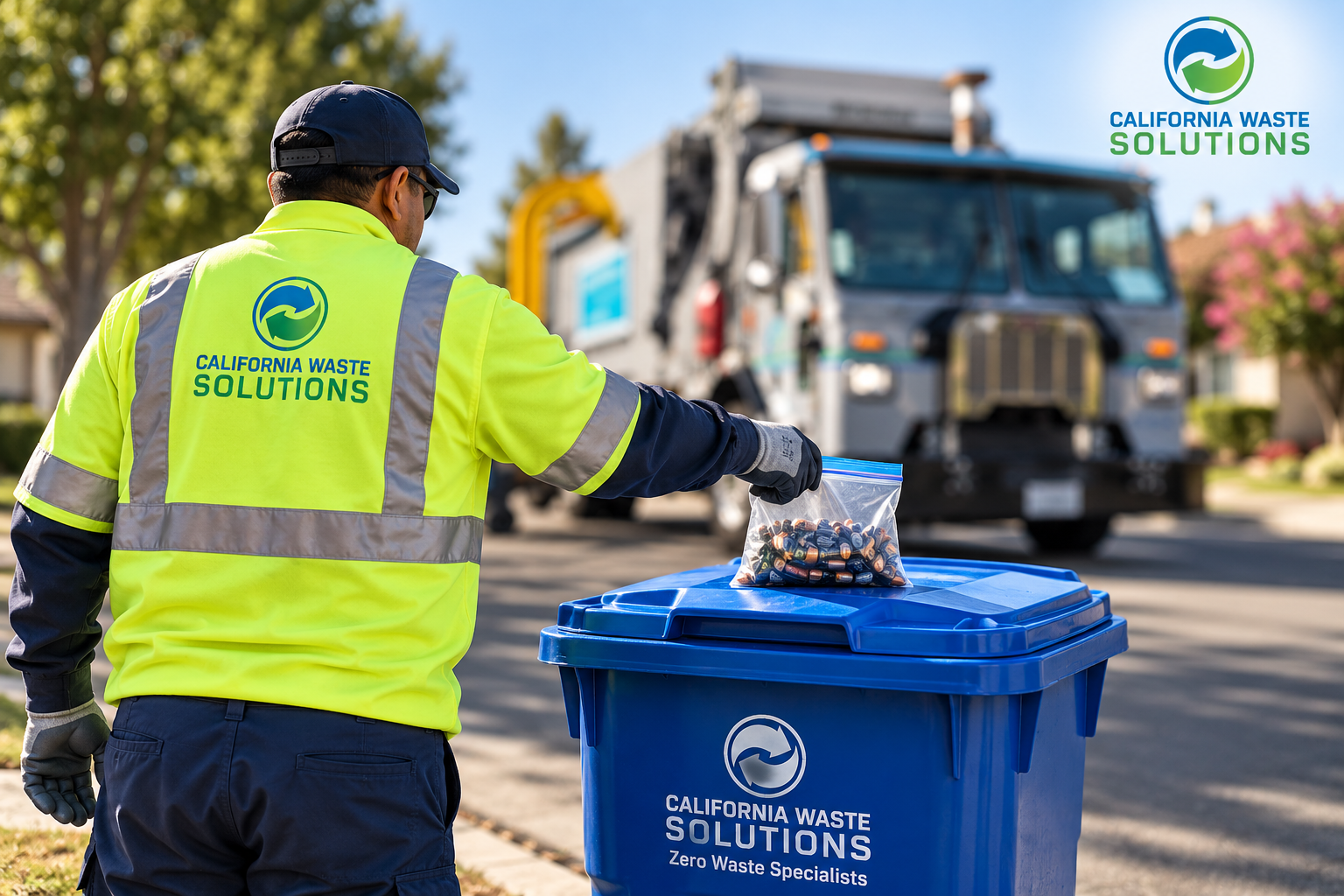
CWS will launch curbside household battery collection in San José in 2027 alongside a new five-year Teamsters agreement.
OAKLAND, CA, UNITED STATES, September 17, 2026 /EINPresswire.com/ — California Waste Solutions, Inc. is making news in San Jose this week with overwhelming support from its employees for a new five-year contract while unveiling a new household battery collection service. The company was also an annual Diamond Sponsor of the Police Department Awards showcasing its commitment to community.
California Waste Solutions’ San Jose employees, represented by the Teamsters, approved a deal offered to them by California Waste Solutions with better pay, more benefits and better vacation time.
The new employee benefits come as California Waste Solutions will begin to collect household batteries at the curb from single-family homes in San Jose beginning in early 2027, extending a cart-top program the company has run for the City of Oakland since 2015.
The two big news events showcase how fundamental motivating employees is to being able to make headway when it comes to offering new services, said Michael Duong, President of California Waste Solutions.
“California Waste Solutions is able to offer the type of services it does to its customers because we are a family company, and our employees are part of that family,” said Duong. “It’s their efforts that enable us to offer the new battery collection and recycling service after all.”
These extra services are made possible because of the company’s relationship with its employees, said Duong.
Sergio Arrañaga, a business agent for Local 350 and chief negotiator for the bargaining unit said: “With this strong contract, they have shown their commitment to raising the bar for workers across the entire waste industry,” said Arrañaga.
ABOUT THE FORTHCOMING BATTERY SERVICE
The service sits inside San Jose’s Recycle Right program, the set of sorting rules residents already follow at home. It is aimed at a narrow and expensive gap in municipal recycling: an item that is recyclable, hazardous in the wrong container, and until now inconvenient to set out.
“One thing hasn’t changed in recycling at all since we began in business over three decades ago, and that’s the importance of recycling batteries right” said David Duong, Founder and Chief Executive Officer of California Waste Solutions. “We have been collecting household batteries at the curb for the past decade in Oakland. We are glad San Jose residents will have that option too.”
Duong founded the company in Oakland in 1992 with eight used collection trucks. CWS now serves more than 343,000 customers in Oakland and San Jose from six Bay Area recycling facilities.
Residents put covered household batteries in a clear, closable plastic bag of about one quart, tape the terminals, seal the bag and set it on top of the recycling cart on the regular collection day. Crews remove the bag before the cart is emptied. The bag never enters the compacted load.
“Everything about this program is designed so the battery never enters the load,” said Michael Duong, president of California Waste Solutions. “Sealed bag, taped terminals, on top of the cart, into a separate compartment on the truck. Four steps, and the material stays isolated from the first one to the last.”
IN DETAIL
The new service takes alkaline and 9-volt cells, plus coin and button lithium-ion batteries of the type used in watches, hearing aids, key fobs and small electronics. It does not take tool and equipment packs, lead-acid or vehicle batteries, or the larger rechargeable lithium-ion packs used in power tools and consumer devices.
But those items are not left outside the recycling system. Santa Clara County runs a free household hazardous waste drop-off program by appointment, and San Jose lists retail take-back sites. CWS says it will support the city’s education on the distinction.
Coin and button cells hold little enough energy to be handled in a sealed bag. Larger lithium-ion packs can enter thermal runaway, generate their own oxygen and resist ordinary suppression. San Jose already warns residents that those cells start fires when they go in the garbage or the recycling cart.
WHERE THE BATTERIES GO
Collected bags stay in a dedicated compartment on the truck for the length of the route. They are consolidated at a CWS facility and sent to a permitted battery recycler. The material does not enter the commingled stream at any point and does not go to landfill. Steel, zinc and manganese recovered from household alkaline cells return to manufacturing.
Recycling a battery costs far more than recycling the paper, glass or plastic collected beside it. Cells are sorted by chemistry, packaged and moved under hazardous-materials rules, then processed at permitted plants. By weight, a household battery is among the costliest items in a residential program but CWS collects it anyway.
“Just as we are willing to spend more on our employees such as in our latest negotiation with the Teamsters, we are willing to pay the premium for better delivery to our customers. For California Waste Solutions, our employees and customers are one and the same: they are the community members we live with, meet at the Mall and eat next to at the cafeteria. That’s why we spend on quality,” said President Michael Duong.
BATTERIES BREAK THE RECYCLING MODEL
CWS operates Pellenc optical sorters and is installing EverestLabs artificial-intelligence scanners on its lines. Those systems identify intact items moving at speed, but they cannot act on a cell that has already failed inside a collection truck.
“We have spent years putting better recognition technology on our lines, and it does exactly what we bought it to do,” Michael Duong said. “It does not solve this one. By the time a battery reaches the plant, the decision that mattered was made at the cart. That is not a technology problem. It is an instruction problem, and it is one we can solve with residents.”
The control point is therefore the cart, not the plant. The resident is the only party who can keep the cell out of the packer. The city and the hauler are responsible for making the instruction clear enough to follow.
As reported in Recycling Today, California Waste Solutions recently announced that it was adding AI technology to its optical sorting systems to better support employees in identifying items on the conveyor belt.
POWERING DOWN COSTS
Fire Rover, which tracks publicly reported fires at waste and recycling operations in the United States and Canada, recorded 448 waste fires in 2025, about 100 of them catastrophic, with losses of roughly $2.5 billion. Waste, paper and plastic plants accounted for about half of the incidents. Batteries were identified as a major contributor.
San Jose has already witnessed a battery fire that destroyed a public recycling center and caused $6.8 million in damage.
CWS is also evaluating infrared cameras, smoke and heat detection, and extinguishing equipment on collection vehicles.
“People do not picture a person when they drop a battery in a cart, and that is fair, because you cannot see us from your driveway,” David Duong said. “But someone rides behind that load, and someone stands over it on the sorting line. They are our employees and they are our family. A sealed bag on top of the cart protects them. So we invest in them.”
California is building a producer-funded battery stewardship system under the Responsible Battery Recycling Act of 2022. CalRecycle is still writing the implementing rules. Until that system is running, the practical route for a household battery in San Jose is the city’s collection program and the company that operates it.
A SHARED SYSTEM
Recycle Right operates on the principle that residents sort correctly, crews handle the bag and the batteries reach a permitted recycle, and it is by that logic CWS says it has organized around since 1992. Oakland and San Jose keep different accepted-material lists. The company publishes city-specific guidance rather than one set of instructions that would be wrong in one of the two cities. It supports that guidance with school visits, neighborhood events, multilingual materials and work with property managers.
“We are a community service company,” David Duong said. “Our job is to make the right thing easy to do, explain it clearly, and handle the material properly after residents have done their part. That is what we owe the cities we serve and the people who live in them.”
ALSO IN THE SAN JOSE DIARY THIS WEEK
California Waste Solutions was once again the Diamond Sponsor of the 2026 San Jose Police Department Major Awards Ceremony.
“This is one evening where the city says out loud what its residents and officers did this year,” said David Duong. “We were proud to sponsor the event again in such a prominent capacity, continuing our five year relationship with the event which started in the middle of Covid-19. It’s another cornerstone commitment we are invested in when it comes to community and the importance of recognizing its highest achievers.”
ABOUT CALIFORNIA WASTE SOLUTIONS
California Waste Solutions Inc. is a family-owned recycling and resource-recovery company headquartered in Oakland. Founded in 1992 by David Duong, it provides collection, processing, customer service and material recovery for residential, commercial and municipal customers in Northern California, including Oakland and San Jose. It operates six Bay Area recycling facilities and serves more than 343,000 customers. City-specific recycling information is at calwaste.com/recycling-guide.
Wendy Nguyen
The King Of Trash
2066045675 ext.
email us here
Visit us on social media:
Instagram
Facebook
YouTube
Legal Disclaimer:
EIN Presswire provides this news content “as is” without warranty of any kind. We do not accept any responsibility or liability
for the accuracy, content, images, videos, licenses, completeness, legality, or reliability of the information contained in this
article. If you have any complaints or copyright issues related to this article, kindly contact the author above.

Media gallery